Rust Doesn't Need a Garbage Collector
G
Gaurav Wankhede - TECHVERSE
2 months ago
2 months ago
Rust Doesn't Need a Garbage Collector — Learn how Rust achieves zero-cost memory management without Stop-The-World latency spikes.
In this video, we uncover why Rust skips the Garbage Collector entirely while remaining 100% memory safe. You'll learn how Tracing Garbage Collectors work in Go, Java, and Python, why Stop-The-World pauses kill real-time performance, and how Rust's RAII (Resource Acquisition Is Initialization) pattern and Drop trait automatically clean up memory at compile time with ZERO runtime overhead.
We break down Bjarne Stroustrup's Zero-Cost Abstraction principle: "What you don't use, you don't pay for. And what you do use, you couldn't hand-code any better in C."
⏱ Timestamps / Chapters:
0:000:00 The 50ms Latency Spike: Why Tracing GC Fails in Real-Time Systems
0:100:10 How Garbage Collectors Work (Java, Go, Python Stop-The-World Pauses)
0:260:26 The Big Question: Memory Safety Without GC or Manual Free?
0:340:34 RAII Explained: Resource Acquisition Is Initialization
0:450:45 Under The Hood: The Drop Trait & Compile-Time Code Injection
0:580:58 Bjarne Stroustrup's Zero-Cost Abstraction Principle
1:081:08 Summary: Tracing GC vs Rust Compile-Time RAII
1:201:20 Next: Ownership & Borrowing — How the Borrow Checker Works
📦 Code & Resources:
www.youtube.com...
www.youtube.com...
▶️ Next Video: Lecture 3 — "Ownership & Borrowing Explained"
🌐 PORTFOLIO & LINKS:
www.gauravwankhede.com
github.com...
#rust #programming #garbagecollection #systems-programming #rustlang #coding
In this video, we uncover why Rust skips the Garbage Collector entirely while remaining 100% memory safe. You'll learn how Tracing Garbage Collectors work in Go, Java, and Python, why Stop-The-World pauses kill real-time performance, and how Rust's RAII (Resource Acquisition Is Initialization) pattern and Drop trait automatically clean up memory at compile time with ZERO runtime overhead.
We break down Bjarne Stroustrup's Zero-Cost Abstraction principle: "What you don't use, you don't pay for. And what you do use, you couldn't hand-code any better in C."
⏱ Timestamps / Chapters:
0:000:00 The 50ms Latency Spike: Why Tracing GC Fails in Real-Time Systems
0:100:10 How Garbage Collectors Work (Java, Go, Python Stop-The-World Pauses)
0:260:26 The Big Question: Memory Safety Without GC or Manual Free?
0:340:34 RAII Explained: Resource Acquisition Is Initialization
0:450:45 Under The Hood: The Drop Trait & Compile-Time Code Injection
0:580:58 Bjarne Stroustrup's Zero-Cost Abstraction Principle
1:081:08 Summary: Tracing GC vs Rust Compile-Time RAII
1:201:20 Next: Ownership & Borrowing — How the Borrow Checker Works
📦 Code & Resources:
www.youtube.com...
www.youtube.com...
▶️ Next Video: Lecture 3 — "Ownership & Borrowing Explained"
🌐 PORTFOLIO & LINKS:
www.gauravwankhede.com
github.com...
#rust #programming #garbagecollection #systems-programming #rustlang #coding
More from this channel

Why Chain of Thought Breaks at Scale
23 days ago

Why Your Brain Lies to You (Fast & Slow Thinking)
25 days ago

7 Triggers That Make You Say Yes (Psychology of Persuasion)
26 days ago

GNAP Protocol in Rust The Simple Way to Production Auth
30 days ago

How I Find YouTube Content Gaps with TubeForge & AI Agents
about 1 month ago

Next.js Alternative? Testing Tokio's Topcoat in Rust
about 1 month ago

GNAP Explained: Why It Replaces OAuth 2.0 and JWT
about 1 month ago

Why MCP Is Overkill for Local Development
about 1 month ago

Rust: Think Iterator, Not Index Loop #rustlang #coding #rust #code #programming
about 1 month ago
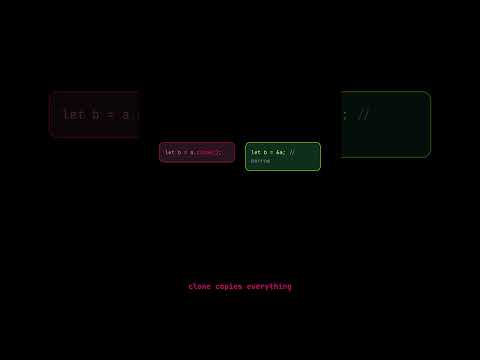
Rust: Stop Using .clone() — It's Technical Debt #rustlang #coding #rust #programming #code
about 1 month ago